

Tokyo Station (Tokyo-eki) is much more than just a transit hub; it is a “city within a city” and the beating heart of Japan’s railway network. Located in the prestigious Marunouchi business district near the Imperial Palace, it serves as the zero-mile marker from which all distances in Japan’s rail network are measured.
For JR Pass holders, this is the most important station in the country. It is the primary terminus for most Shinkansen (bullet train) lines connecting Tokyo to the north, west, and south. Whether you are rushing to catch a train to Kyoto or exploring the historic red-brick architecture, understanding the station’s layout is essential.
Table of Contents
Tokyo Station: Quick Facts
| Feature |
Details |
|---|---|
| Japanese Name | Tokyo-eki (東京駅) |
| Opened | December 20, 1914 |
| Daily Passengers | Approx. 434,500 (JR East boarding only) |
| Main Entrances | Marunouchi (West/Imperial Palace) & Yaesu (East/Shinkansen) |
| Key Shinkansen Lines | Tokaido, Tohoku, Yamagata, Akita, Joetsu, Hokuriku |
| Airport Access | Narita: ~53 min (Narita Express)
Haneda: ~30 min (JR + Monorail) |
Tokyo Station Layout: Marunouchi vs. Yaesu
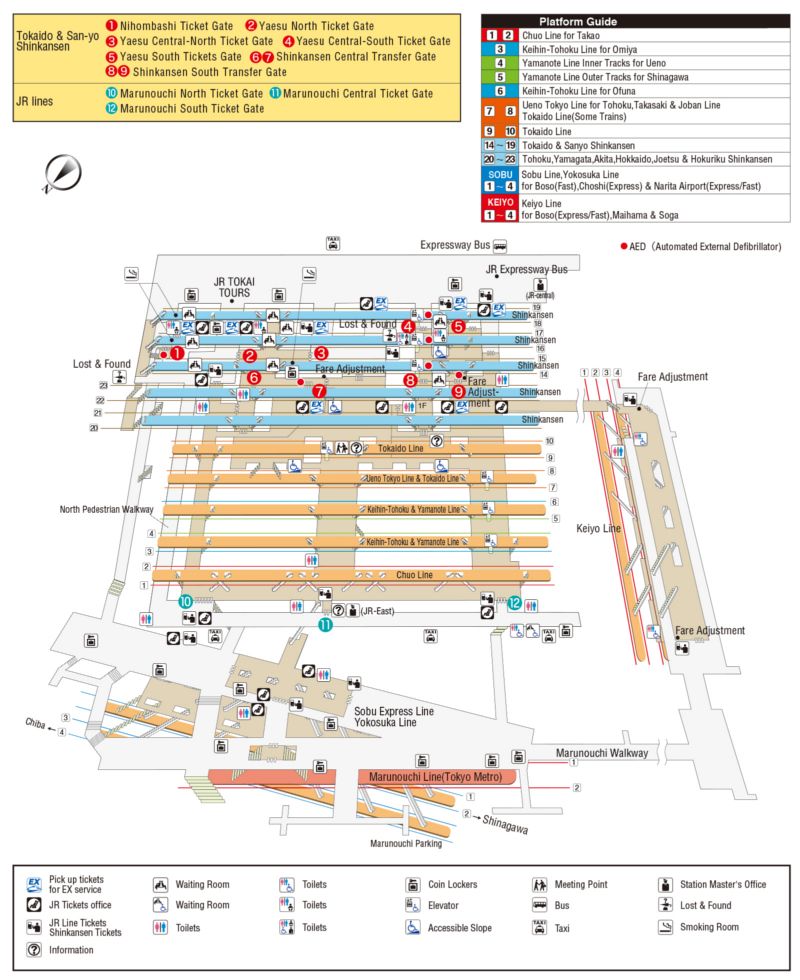
Tokyo Station is massive, but navigating it is simple once you understand its two distinct sides. The station is oriented West to East.
Marunouchi Side (West)
This is the historic face of the station, characterized by the iconic red brick building restored to its original 1914 splendor.
- Best for: Accessing the Imperial Palace, high-end dining at the Marunouchi Building, and taking classic tourist photos.
- Exits: Marunouchi North, Marunouchi Central, and Marunouchi South.
- Connection: This side connects directly to the Tokyo Metro Marunouchi Line.
Yaesu Side (East)
This is the modern, commercial side of the station featuring the glass “GranRoof” and skyscrapers.
- Best for: Shinkansen (Bullet Train) access, Highway Buses (Bus Terminal Tokyo Yaesu), and the Daimaru Department Store.
- Exits: Yaesu North, Yaesu Central, and Yaesu South.
- Connection: This side offers the quickest access to “Tokyo Character Street” and “Tokyo Ramen Street” in the underground mall.
Platform Layout and Shinkansen Gates
Tokyo Station generally uses elevated platforms for most trains, with two major exceptions.
- Shinkansen Platforms (Tracks 14-23): These are located on the Yaesu (East) side. If you enter from the Marunouchi historic side, you must walk through the central passage to the Yaesu side to find the Shinkansen ticket gates. Look for the green Shinkansen icons on the overhead signage.
- Regular JR Lines (Tracks 1-10): Located on the upper level between the two sides (including Yamanote, Keihin-Tohoku, and Chuo lines).
- Narita Express / Yokosuka Line (Deep Underground): Located on the Marunouchi side at the B5 level. These are significantly far from the main platforms; allow 10–15 minutes to transfer here.
Did you know? The current Japanese ¥10,000 banknote, released in 2024, features Shibusawa Eiichi, a key industrialist instrumental in founding the railway companies that led to Tokyo Station’s creation. The station’s red brick aesthetic is a symbol of the modernization era he championed.
JR Lines at Tokyo Station
As the central hub of the Japan Railways network, your Japan Rail Pass covers the vast majority of lines here.
Shinkansen Lines
Tokyo Station is the terminus for the following bullet train lines:
- Tokaido Shinkansen (connecting to Sanyo Shinkansen):
- Runs to Nagoya, Kyoto, and Shin-Osaka.
- Through-service: Many trains (Nozomi-Hikari) continue directly onto the Sanyo line to Hiroshima and Fukuoka (Hakata Station) without requiring a transfer.
- Departing from platforms 14-19.
- Tohoku Shinkansen (connecting to Hokkaido Shinkansen):
- Runs to Sendai, Morioka, and Shin-Aomori.
- Through-service: The Hayabusa train continues directly onto the Hokkaido line to Shin-Hakodate-Hokuto.
- Departing from platforms 20-23.
- Yamagata Shinkansen: To Yamagata and Shinjo.
- Akita Shinkansen: To Akita.
- Joetsu Shinkansen: To Niigata.
- Hokuriku Shinkansen: To Nagano and Kanazawa.
Other JR Lines
- Yamanote Line: The city loop line (Green).
- Chuo Line: Rapid service to Shinjuku and Takao (Orange).
- Keihin-Tohoku Line: To Saitama and Yokohama (Blue).
- Sobu Line (Rapid): To Chiba.
- Yokosuka Line: To Kamakura and Kurihama.
- Keiyo Line: To Maihama (Tokyo Disney Resort). Note: The Keiyo line platform is located several hundred meters south of the main platforms.

Non-JR Lines
While the JR Pass covers the lines above, Tokyo Station also connects to the Tokyo Metro Marunouchi Line (Subway). This underground line is convenient for reaching Ginza, Shinjuku, and Ikebukuro but requires a separate ticket or IC Card (like Suica or Pasmo).
How to Exchange your JR Pass at Tokyo Station
Because Tokyo Station is a major entry point for travelers, the JR Exchange Offices here can be very busy.
You can exchange your Exchange Order for the actual rail pass at:
- JR East Travel Service Center (Marunouchi North Exit): usually open 7:30–20:30.
- JR Central Ticket Office (Yaesu North Exit): usually open 7:30–20:30.
- JR Tokai Tours (Yaesu Central Exit): usually open 8:00–18:00.
Tip: If the lines at the Marunouchi North center are long, try walking through the passage to the Yaesu side, which sometimes has shorter wait times.
Tokyo Station to Narita Airport
The most comfortable and direct way to reach Narita Airport is the Narita Express (N’EX).
- Platform: Sobu/Yokosuka Underground Platforms (Tracks 1-4, Marunouchi side).
- Time: Approx. 53 minutes to Narita Terminal 1.
- Cost: Approx. ¥3,070 (Regular seat).
- JR Pass: Fully covered. You must make a seat reservation at a ticket machine or office before boarding.
Alternative: The “Airport Bus Tokyo-Narita” (Low Cost Bus) departs from the Yaesu Exit and costs roughly ¥1,300, but is subject to traffic conditions.
You can also check our guide to get from Narita Airport to Tokyo.
Tokyo Station to Haneda Airport
There is no direct train, but access is fast via a single transfer.
- Take the JR Yamanote Line or JR Keihin-Tohoku Line to Hamamatsucho Station (approx. 6 mins).
- Transfer to the Tokyo Monorail to Haneda Airport (approx. 20 mins).
- Cost: ~¥670 total.
- JR Pass: Both the JR line to Hamamatsucho and the Tokyo Monorail are fully covered.
You should also consider the details when traveling from Haneda Airport to Tokyo.
Things to Do in and Around Tokyo Station
If you have a layover or some spare time, the station itself is a major tourist destination.
Visit the Tokyo Imperial Palace and East Gardens
Exit via the Marunouchi Central Exit and walk straight down the broad Gyoko-dori avenue. In about 10 minutes, you will reach the Imperial Palace grounds. While the inner palace is generally closed, the East Gardens are open to the public (closed Mondays and Fridays) and offer a peaceful escape from the city.
Savor the Flavors of Tokyo Ramen Street
Located in “First Avenue Tokyo Station” (underground on the Yaesu side), this corridor features eight of Tokyo’s most famous ramen shops, including the legendary Rokurinsha. It is the perfect place for a quick, high-quality meal. You will typically buy a ticket from a vending machine before queuing.
Immerse Yourself in Tokyo Character Street
Adjacent to Ramen Street, this alley is lined with over 30 shops dedicated to Japanese pop culture icons. You will find official stores for Pokémon, Studio Ghibli, Hello Kitty, Rilakkuma, and Shonen Jump anime series. It is an excellent spot for buying souvenirs.
Discover Tokyo Station Gallery
Located inside the Marunouchi North Dome, this art museum hosts rotating exhibitions in a space that highlights the station’s original red-brick walls and steel beams. It is a great way to see the history of the building up close.
Cover picture: Evenliu Photography