
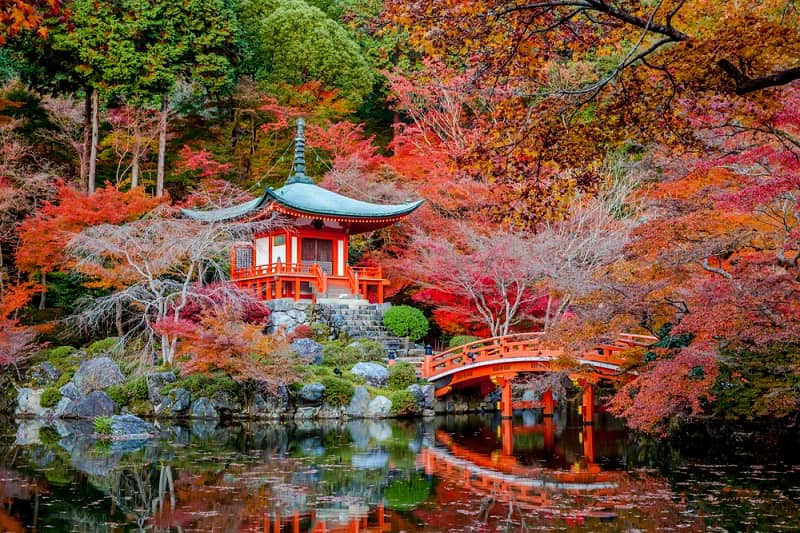
Many travelers often consider autumn in Japan to be the most beautiful time to visit.
As temperatures dip after the scorching summer, the colors of the leaves change into vibrant shades of orange, red, yellow, and brown. This natural phenomenon is called koyo or momiji (meaning red leaves).
Japanese fall foliage is a magnificent sight that has inspired artists and poets for centuries, and travelers come from all over the world to view it.
This guide explains what autumn in Japan is like and when to expect the country’s fall foliage in 2026.
Table of Contents
When is Autumn in Japan?
Fall in Japan generally spans from September through early December, with the timing of fall colors depending heavily on the region.
The season typically begins in Hokkaido around mid-September, when cooler air arrives earlier due to its northern location.
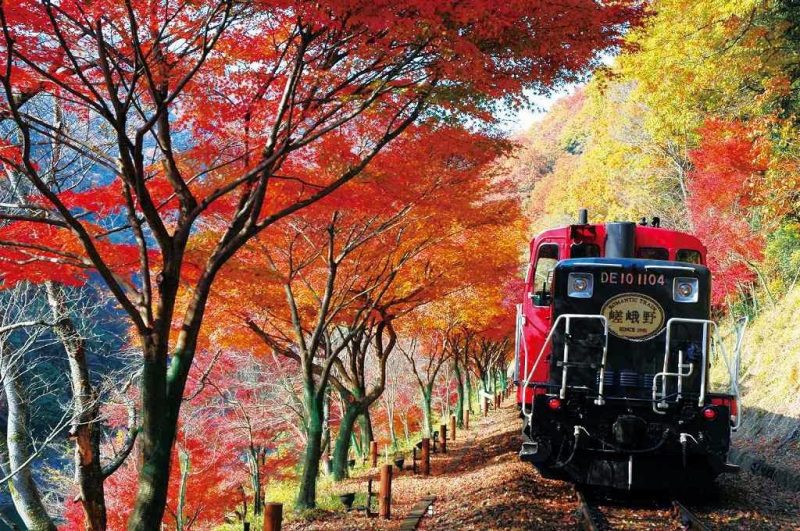
The colors then sweep southward, reaching central Japan between mid-October and late November, and continuing into December in the milder southern areas.
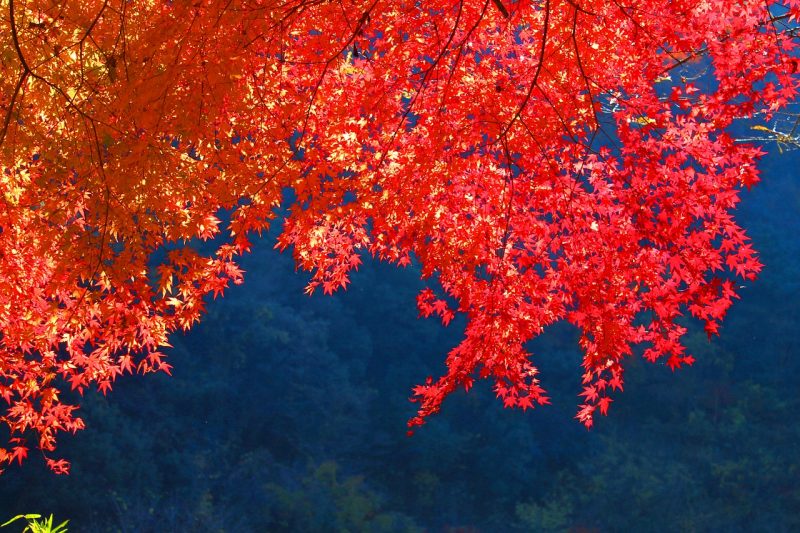
The period is commonly referred to as the maple leaf season, or momiji season, because the brilliant red hues of Japanese maple trees are the most iconic autumn sight.
Fall foliage forecast for 2026
The turning of the leaves in Japan varies due to temperature, elevation, and latitude, and the best time to experience it differs every year.
In general, the autumn foliage season begins in the northern and mountainous areas of Japan before gradually moving south and to lower elevations.
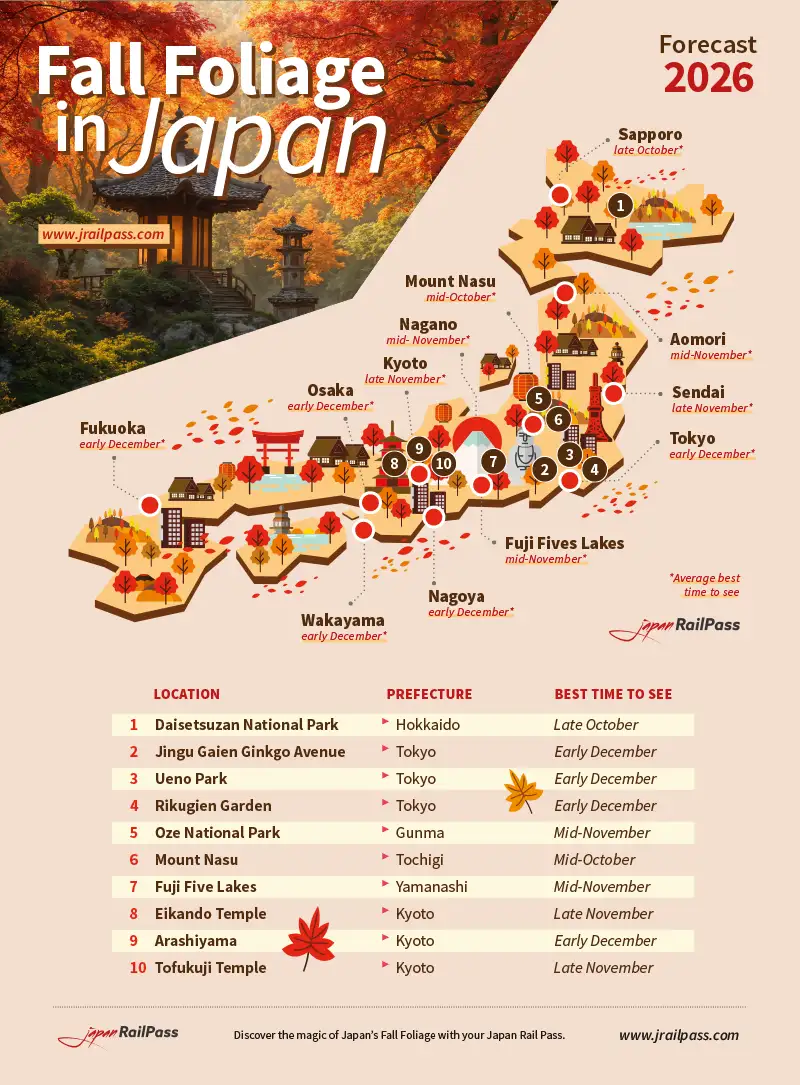
For 2026, warmer-than-average autumn temperatures are expected across much of Japan. As a result, the best viewing period for red and yellow leaves is forecast to be around average or later than average in many areas.
According to the first official 2026 forecast, released on September 2, red leaves are expected to reach their best viewing around:
Here’s a look at the typical timing of autumn color changes and peak viewing periods across key regions of Japan:
| Region / city | Typical start of color change | Peak viewing period |
| Hokkaido (Daisetsuzan, Sapporo, Hakodate) | Mid–September | Late September – Early October |
| Tohoku (Aomori, Nikko, Sendai) | Late September | Early – Mid October |
| Nagano & Japanese Alps (Kamikochi, Tateyama) | Late September | Early – Mid October |
| Kanto (Tokyo, Nikko, Hakone) | Mid–October | Late October – Mid November |
| Kansai (Kyoto, Osaka, Nara) | Mid–October | Mid November – Early December |
| Chubu (Takayama, Kanazawa, Mt. Fuji area) | Mid–October | Early – Mid November |
| Chugoku (Hiroshima, Okayama) | Late October | Mid – Late November |
| Shikoku (Matsuyama, Iya Valley) | Late October | Mid – Late November |
| Kyushu (Fukuoka, Kumamoto, Nagasaki) | Early November | Mid November – Early December |
These Momiji forecasts are to be used as a guide only. Foliage displays can change depending on temperatures and weather conditions during the autumn season.
Momijigari: Red leaf hunting
Autumn in Japan is known as Aki (秋) and the fall foliage is commonly described using 2 terms: Koyo (紅葉) and Momiji (紅葉).
Koyo describes red and yellow fall colors, while Momiji specifically applies to the intensely red maple leaves that are particularly notable during the season.
The activity of searching for the most striking shades of red fall leaves is known as Momijigari (red leaf hunting). It has been popular in Japan for centuries and is now a major draw for tourists.
The JR Pass gives you unlimited access to transportation all around Japan for 7, 14, or 21 days, including Shinkansen.
A single ticket, huge savings.
The history of Momijigari
The tradition of Momijigari has had a profound influence on Japanese culture since the Heian period (794-1195), with hunting for maples particularly popular across the country.
Momijigari features heavily in eighth-century Manyoshu poetry, and the classical Heian Period novel ‘The Tale of the Genji’.
For Buddhists, it’s a moment that’s important both spiritually and symbolically, as it reminds us that life is passing.
The cultural significance of maple leaves
The maple leaf symbolizes fall in Japanese culture, and features widely in seasonal traditions.
Maple-shaped cakes are typical during the fall, and the leaves themselves are often eaten as tempura. There are various varieties of maple leaf tempura served throughout the country during the season, often accompanied by a cup of Japanese tea.
Planning an autumn trip to Japan
If you want to experience Momijigari in Japan, it’s advisable to start planning your trip around 6 months in advance, particularly if you wish to visit the most popular locations.
For Momijigari trip inspiration, see our guide to the best places to see autumn leaves in Japan.
Like the cherry blossom season in the spring, accommodation in Tokyo and Kyoto can fill up quickly for the fall foliage season, soyou’re recommended to make reservations as soon as possible.
It’s always a good idea to check the annual fall foliage forecast as soon as it’s available, as the exact dates for the best time to see autumn leaves in Japan can vary by year and region.